
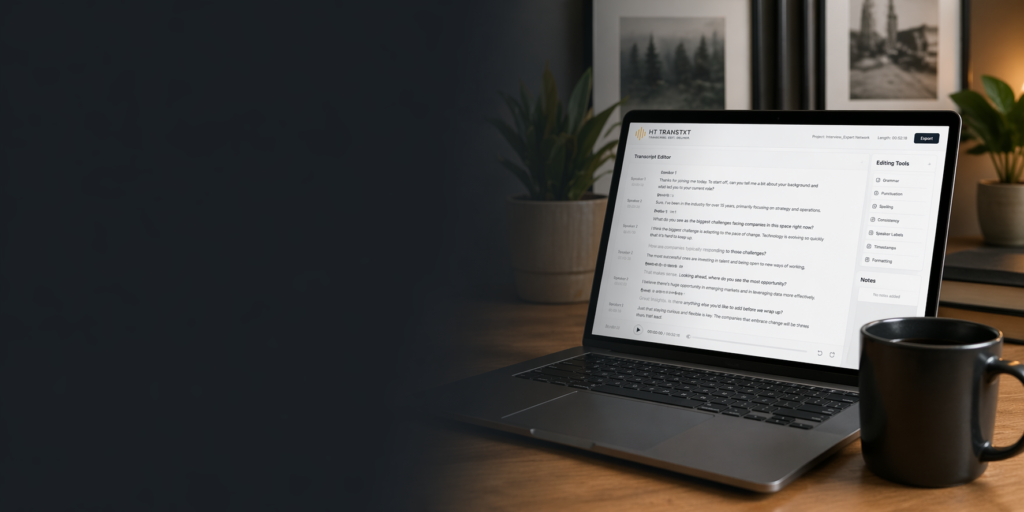
AI Transcript Cleanup Service
Fast. Accurate. Reliable.
We take your AI-generated transcripts, clean them up and turn them into polished, accurate, and professional documents – ready to use.

Standard Delivery
(48 Hours)
R10.00/audio minute

Urgent Delivery
(24 Hours)
R15.00/audio minute

Express Delivery
(Same Day)
R20.00/audio minute
AI is Fast. We Make It Flawless.
AI transcripts are a great start, but they often miss the nuances that matter. Our expert transcribers refine your transcripts for clarity, accuracy, grammar, punctuation, and formatting, so you get a final document you can trust.
What We Fix
Get a Quote
Who This is for
Businesses & Corporates
Content Creators
Educators & Trainers
Researchers
Professionals
Why Businesses Choose HT TRANSTXT

Human Expertise
Our professional transcribers ensure accuracy that AI can’t guarantee.

Industry Experience
We work with businesses, professionals, and organizations across various industries.

Secure & Confidential
Your data is handled with the highest level of confidentiality and security.

Flexible Turnaround
Choose the delivery speed that suits your deadlines and budget.

Clear, Readable Formats
Well formatted transcripts that are easy to read and use.

Support You Can Rely On
Our team is here to help before, during, and after your order via Live Chat.
Before & After
Raw AI Transcript
(0:01) Thank you for taking the time to speak with us today, we’re currently conducting a deep dive into the sas scalability of the platform specifically (0:05) regarding the API integration (0:08) with legacy ERP systems like SAP S4 Hana and Oracle. (0:10) Could you walk us through the current latency issues you’ve identified during the due diligence phase. (0:18) Yes, absolutely. Currently the primary bottleneck is in the asynchronous data calls, while the front end remains relatively responsive, (0:25) the sequel database at the back end isn’t optimized for the current transaction volume we see (0:28) during peak South African business hours, specifically when the batch processing kicks in for mid-market clients (0:30) we’re seeing a latency pike of about 200 milliseconds. (0:33) It’s a system down scenario, but it’s enough to degrade the user experience significantly. (0:36) Interesting. If we were to pivot to a microservices architecture to handle the load (0:40) how would that impact your burn rate over the next fiscal quarter. (0:43) We’re trying to model the evita impact for the post acquisition integration. (0:45)
Polished Human Transcript
JOHN SMITH: Thank you for taking the time to speak with us today. We’re currently conducting a deep dive into the SaaS scalability of the platform, specifically regarding the API integration with legacy ERP systems like SAP S/4HANA and Oracle.
Could you walk us through the current latency issues you’ve identified during the due diligence phase?
JOE BROWN: Yes, absolutely. Currently, the primary bottleneck is in the asynchronous data calls. While the front end remains relatively responsive, the SQL database at the back end isn’t optimized for the current transaction volume we’re seeing.
During peak South African business hours, specifically when the batch processing kicks in for mid-market clients, we’re seeing a latency spike of about 200 milliseconds. It’s not a system-down scenario, but it’s enough to degrade the user experience significantly.
JOHN SMITH: That’s interesting. If you were to pivot to a microservices architecture to handle that load, how would that impact your burn rate over the next fiscal quarter? We’re trying to model the EBITDA impact for the post-acquisition integration.
How It Works
Place your order online
FAQs
Q: Can you clean up transcripts from Zoom, Otter, or Microsoft Teams?
A: Yes. We take your existing AI-generated drafts and perform a deep-dive audit to correct terminology, speaker attribution, and technical errors that automated systems miss.
Q: Why should I pay for AI transcript fixing instead of a full human transcription?
A: AI editing is a cost-effective middle ground. You get the speed of AI with the “Gold Standard” accuracy of a human ear, ensuring your document is legal-ready without the full cost of manual entry.
Q: Do you handle South African accents and local terminology?
A: Absolutely. One of the biggest failures of global AI is local nuance. We specialize in South African cadences and industry-specific jargon that standard algorithms often misinterpret.
Need A Full Transcription Services?
Legal Transcription | Investment Research Transcription | Business Transcription