
Last Updated on 01/06/2026 by Liza Brits
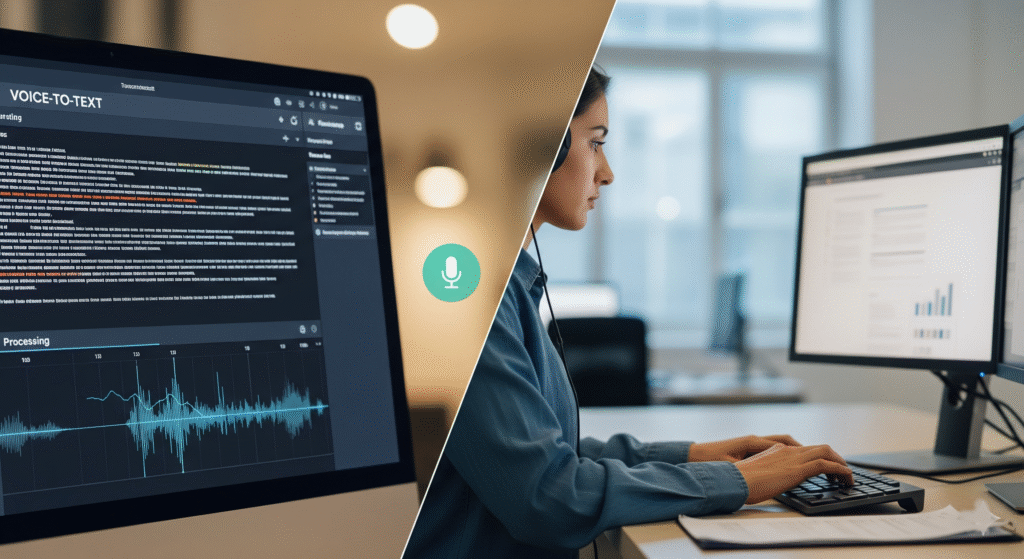
In a world that values efficiency and accessibility, transcription has become a vital tool for businesses, researchers, and content creators. The debate between human vs AI transcription isn’t about which one is better, but rather which one is the right fit for your specific needs.
Each method has a unique set of advantages and disadvantages that make it ideal for different situations.
What Is Human Transcription?
Human transcription is the traditional method, relying on trained professionals to listen to audio or video recordings and manually convert the spoken words into text. It’s a meticulous process that often involves multiple passes to ensure a high degree of accuracy and attention to detail.
✅ Advantages of Human Transcription
- Exceptional Accuracy: Humans can decipher and transcribe complex audio with a high degree of accuracy, often exceeding 99%. They excel at handling challenging elements like background noise, overlapping speakers, and mumbled words.
- Contextual Understanding: A human transcriber understands nuances that machines miss, such as tone, emotion, sarcasm, and implied meaning. They can also correctly interpret homonyms and homophones based on the context of the conversation.
- Handling of Complex Content: Human transcribers can accurately transcribe specialized jargon, technical terms, and proper nouns in fields like law, medicine, and academia.
- Customization and Formatting: They can follow specific client instructions for formatting, speaker labeling, and time stamping. This allows for customized transcripts that are tailored to the exact requirements of a project.
Learn more in our guide on Human Transcription and Learn Why It Still Reigns Supreme in 2026.
❌ Disadvantages of Human Transcription
- Slower Turnaround Time: The manual nature of the work means it can take a little longer to complete a transcription, especially for longer files. However, HT TRANSTXT does offer expedited services for a faster turnaround time.
- Higher Cost: Human transcription is more expensive due to the labor involved.
What Is AI Transcription?
AI transcription uses automated speech recognition (ASR) software and machine learning to convert spoken language into text. The process is incredibly fast, with an algorithm processing audio and generating a transcript in a fraction of the time it would take a human.
✅ Advantages of AI Transcription
- Unmatched Speed: AI can transcribe an hour of audio in just minutes, making it the ideal choice for projects with tight deadlines or real-time transcription needs.
- Cost-Effectiveness: Because it requires minimal human intervention, AI transcription is significantly cheaper than human services. Many platforms offer subscription models that are perfect for high-volume users.
- Scalability: AI tools can handle a massive volume of audio files simultaneously, allowing businesses to process huge amounts of data efficiently.
- Accessibility and SEO: Transcripts generated by AI can quickly be used to create captions and subtitles, making content more accessible. They also boost a website’s search engine optimization (SEO) by providing keyword-rich text that search engines can index.
❌ Disadvantages of AI Transcription
- Lower Accuracy: While AI technology has improved, it still struggles with accuracy, particularly with poor audio quality, strong accents, multiple speakers, or complex jargon.
- Lack of Nuance: AI cannot interpret the emotional context or subtle cues in a conversation. It also has trouble with homophones and other linguistic complexities.
- No Customization: Most AI tools produce a standard, word-for-word transcript that may lack proper punctuation, speaker identification, and specific formatting required for professional documents.
- Security Concerns: Many AI services are cloud-based, which can raise concerns about data security and confidentiality, especially for sensitive or confidential information.
Human vs AI Transcription: The Right Choice for You
Deciding between human and AI transcription comes down to your priorities. If your project demands speed, cost-effectiveness, and high volume for straightforward audio, AI transcription is your best bet. It’s perfect for quickly generating rough drafts, creating transcripts for content repurposing, or for use in informal settings like internal team meetings.
However, if your project requires superior accuracy, contextual understanding, and a polished final product, then human transcription is the only way to go. This is especially true for critical fields like legal, medical, and academic research, where every word matters.
Ultimately, a hybrid transcription approach often provides the best of both worlds: using AI to create a fast, initial draft, then having a human editor review and refine it for accuracy, context, and proper formatting. By understanding the unique strengths of each method, you can make an informed decision that optimizes your workflow and ensures you get the exact transcript you need.
A fantastic example of the hybrid approach in action is in the legal and medical fields. These industries have a critical need for flawless accuracy, but they also have a high volume of work that needs to be completed efficiently.
Here’s how a typical hybrid workflow operates:
1. The Initial AI Transcription Draft:
- A law firm has hours of audio from a deposition, or a hospital has recordings of doctor-patient consultations.
- Instead of assigning the entire workload to a human transcriber from scratch, the audio files are first run through a sophisticated AI transcription engine.
- This AI quickly generates a rough, time-stamped transcript. This draft is essentially the “skeleton” of the final document. It captures the majority of the words and provides a searchable text document in minutes.
2. The Human Editor’s Refinement:
- The AI-generated draft is then passed to a professional human transcriber who specializes in the legal or medical field.
- This human expert is not transcribing from scratch; they are a highly skilled editor. They listen to the original audio alongside the AI draft.
- They meticulously correct any errors the AI made, such as:
- Misinterpreted jargon: The AI might have transcribed “Tylenol” as “tie and all,” which the human editor immediately corrects.
- Speaker identification: The AI may have confused “Speaker 1” and “Speaker 2.” The human editor properly labels each speaker by name and ensures consistency.
- Contextual errors: The AI might transcribe a homonym incorrectly, like “their” instead of “they’re,” but the human editor understands the context and makes the right choice.
- Inaudible sections: The AI will often mark sections it couldn’t understand as
(inaudible). The human editor, with their superior listening skills and contextual knowledge, can often decipher these sections. - Punctuation and formatting: The human editor adds proper punctuation, paragraphs, and formatting to create a clean, professional document that is easy for a lawyer or doctor to read and reference.
The Result of This Hybrid Transcription Model is a Win-Win:
- Speed: The initial AI pass drastically reduces the overall turnaround time compared to a purely manual process.
- Cost: The cost is lower than a full human transcription because the AI has already done the bulk of the work, reducing the time a human has to spend on the file.
- Accuracy: The human review ensures the final transcript is highly accurate, contextually relevant, and correctly formatted, meeting the strict standards required for legal and medical documentation.
This hybrid transcription approach leverages the speed and scalability of AI while preserving the critical accuracy and nuanced understanding that only a human can provide. It’s the perfect solution for tasks where both speed and precision are non-negotiable.
Cost Comparison: Human vs AI Transcription, and Hybrid Method
| Feature | Human Transcription | AI Transcription | Hybrid (AI + Human) |
|---|---|---|---|
| Accuracy | 98–100% with nuanced understanding | 80–95%, depends on audio quality | 99%+, AI draft polished by human editor |
| Speed | Several hours (depending on length) | Minutes per hour of audio | Faster than human-only, slower than AI-only |
| Cost | Highest (per audio minute) | Lowest (subscription or pay-per-use) | Mid-range (AI reduces human workload) |
| Best For | Legal, medical, research, high-stakes content | Team meetings, podcasts, quick drafts, captions | Industries needing both speed & accuracy |
| Customization | Formatting, timestamps, speaker labels, NDAs | Basic transcripts with limited formatting | AI output refined to client specifications |
| Security | Confidentiality agreements & secure handling | Cloud-based, possible data privacy risks | Flexible – depends on service provider |
Security & Confidentiality
When choosing between human and AI transcription, it’s essential to consider how your data is handled:
- AI Transcription: Most AI transcription tools operate in the cloud, which allows for fast processing and scalability. However, this also raises privacy concerns, especially if your audio contains sensitive information. Always check if the service encrypts data in transit and at rest, and whether they have a clear privacy policy regarding data retention.
- Human Transcription: Professional human transcription services often provide NDAs (Non-Disclosure Agreements) and secure file handling. This ensures that confidential meetings, medical records, or legal proceedings are protected. For highly sensitive content, human transcription or a hybrid model where AI generates a draft but humans handle sensitive sections is usually the safest approach.
- Hybrid Transcription Approach: Combining AI and human transcription can offer the best of both worlds: speed and efficiency from AI, plus secure human oversight for critical portions of the audio.
Use Cases & Industry Applications
- Business meetings & corporate use (AI for quick minutes, human for polished official records).
- Podcasts & content creation (AI for drafts, human for final published transcripts).
- Legal (strict accuracy standards, human or hybrid only).
- Medical (confidentiality + accuracy = human/hybrid).
- Education & research (AI for fast note-taking, human for published studies).
Frequently Asked Questions: Human vs AI Transcription
Which is more accurate, human or AI transcription?
Human transcription is more accurate, especially with complex audio, multiple speakers, or specialized terminology. AI transcription can be fast, but its accuracy depends on audio quality and clarity.
Is AI Transcription suitable for legal or medical content?
AI transcription can be used for rough drafts or internal notes, but for legal or medical documents where accuracy and confidentiality are critical, human or hybrid transcription is recommended.
Can AI handle multiple speakers accurately?
AI transcription may struggle with multiple speakers, especially if they speak over each other or have similar voices. Human transcribers excel at speaker identification and context interpretation.
How secure are online AI transcription services?
Security varies by provider. Cloud-based AI tools may store or process data off-site, so check encryption practices and privacy policies. For highly sensitive content, human or hybrid transcription is safer.
What is the fastest transcription method?
AI transcription is the fastest, generating transcripts in minutes. Hybrid approaches combine AI speed with human accuracy for optimal results.